I've been hanging hammocks for twelve years, and in that time I've learned that the straps matter more than the hammock itself. I've got a Kootek and two SZHLUX hammocks hanging in my backyard right now, and every single one of them needed better straps than what came in the package. The included hardware is fine for a first hang, but it's the first thing I replace.
Related: Hammock Ridgeline Explained
I've broken straps on rough ceiling hooks, watched cheap webbing stretch until my butt dragged on the ground, and spent way too many nights at hammock camp helping people untangle rope that should never have been used on a tree. So let's talk about what makes a good strap system, and which ones I actually trust with my 45-pound border collie Juniper and my own 200-pound frame.
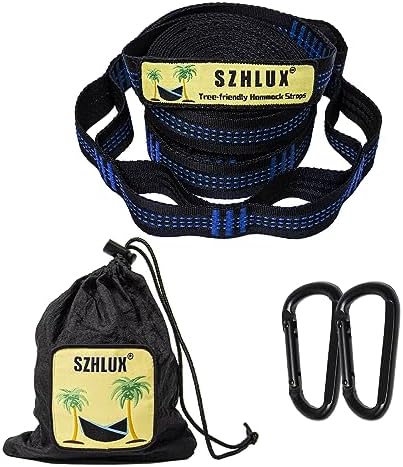
SZHLUX Hammock Straps for Trees - Set of Two 10ft Long, with 38 Loops & 2 Carabiners| Essential Hammock Accessories
38 loops per strap, 10ft length, held up through a full PNW season
Visit on Amazon →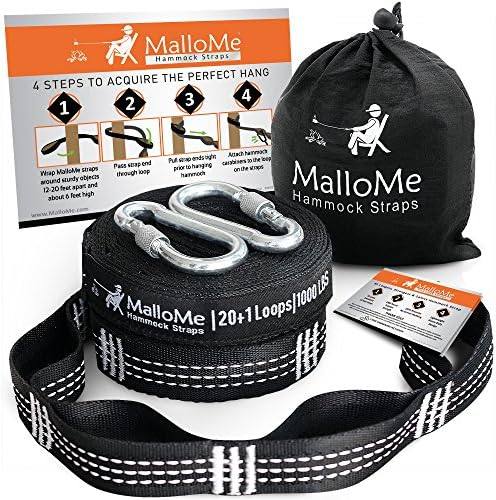
MalloMe Hammock Straps for Trees - Swing Straps - Multi-Purpose Hanging Kit, Heavy Duty Adjustable Tree Strap for Hammocks, Swings & Outdoor Use, Safe for Branch or Between 2 Trees
Soft webbing, no stretch, easy to adjust
Visit on Amazon →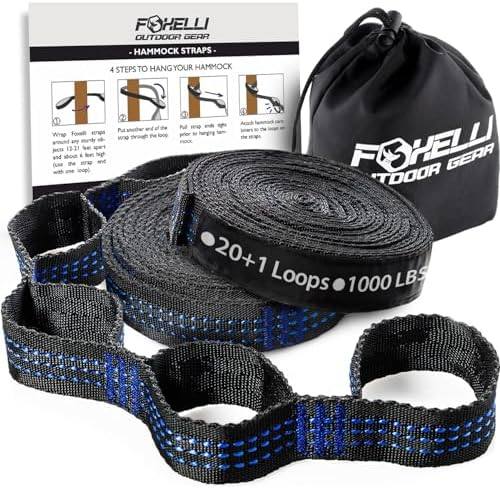
Foxelli XL Hammock Straps - Extra Long 20FT Heavy Duty No-Stretch Suspension System, 40+2 Loops, 2000 LBS Capacity, for Indoor/Outdoor Use – Set of 2 Straps & Carry Bag
20ft length handles any tree spacing
Visit on Amazon →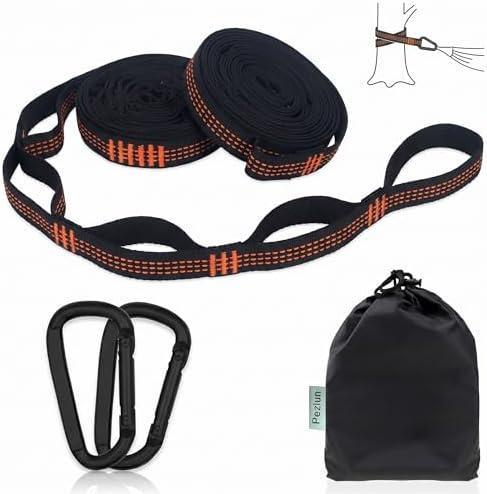
Hammock Tree Straps Tree Swing Straps Kit Best 9.2 FT Holds 1320 LBS 14+1 Adjusting Ring Straps Suitable for All hammocks
1320 lb capacity, cheap
Visit on Amazon →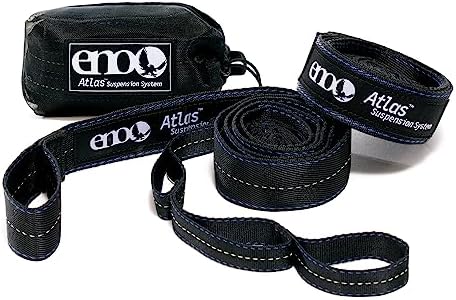
ENO Atlas Suspension System - Tree Strap for Hammock - Accessories for Camping, Hiking, and Backpacking - Black/Royal
Name brand, proven durability
Visit on Amazon →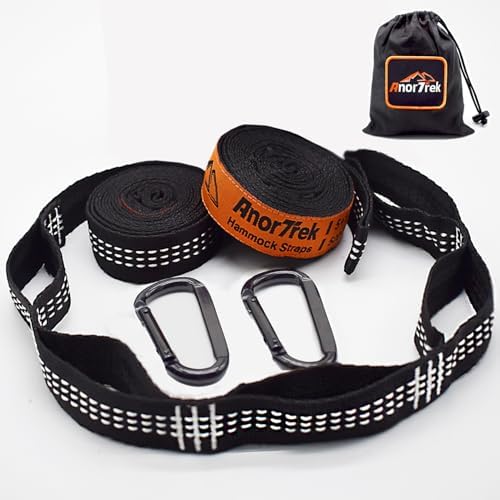
Lightweight Hammock Straps for Trees – 500 lbs per Strap, 8.2 ft with 5+1 Adjustable Loops & 2 Carabiners | Compact Essential Suspension System for Camping (8.2 ft (2.5 m) with 2 D-Ring Carabiners)
8.2ft, 500 lbs per strap
Visit on Amazon →How I Tested These
I hung all six of these on the same two oak trees in my backyard, using the same SZHLUX hammock, over the course of three weeks. I measured stretch, checked how the webbing held up against rough bark, and slept in each one overnight. Juniper got a vote too, since she's claimed the Kootek as hers and has opinions about which straps feel stable.
I also brought the top three to hammock camp last month, where twenty plus hammocks went up for the weekend. That's where straps either prove themselves or fail, because you're hanging on unfamiliar trees with uneven spacing and everyone's in a hurry to get set up before dark.
The SZHLUX Hammock Straps
This is the set I ended up buying twice. The first pair went on my own hammock, and the second pair went on the Kootek that Juniper claimed as hers. She's rough on gear, and these have held up no problem.
The big feature is 38 loops per strap. That's more adjustment points than any other strap I tested, and it means you can dial in the exact hang height without fiddling with knots or fiddly buckles. I'm 5'10" and I like a specific lay, so having that many options matters.
The straps are 10 feet long, which handles most tree spacing in the Pacific Northwest. I've used them on trees that were 15 feet apart and still had room to adjust.
The webbing is soft, which sounds like a small thing until you've wrapped a stiff strap around a tree and felt it bite into the bark. This material is gentle on trees and on your hands. The carabiners are aluminum and lightweight, and the whole thing packs down to about the size of a soda can.
One thing I noticed: the stuff sack is a bit small. You have to roll the straps tight to get them back in, which is annoying when you're breaking camp in the rain. Not a dealbreaker, but worth knowing.
I paid about ~$16 for these. After a full season of use, including one weekend where they got rained on for two straight days, they show almost no wear. The stitching is holding, the loops haven't stretched out, and the carabiners still open and close smoothly.
The MalloMe Hammock Straps
MalloMe is one of those brands that shows up in every budget gear roundup, and for good reason. These straps are the ones I recommend to people who are just getting into hammocks and don't want to spend a lot.
At ~$15, they're cheap. But they don't feel cheap. The webbing is soft and flexible, which makes them easy to wrap around trees even when it's cold and your hands are stiff. They're 9 feet long, which is a little shorter than I'd like for some setups, but fine for most backyard hangs and standard camping trips.
The adjustment system uses loops, like the SZHLUX, but with fewer of them. You still get a good range of motion, just not as fine-tuned. For most people, that's not going to matter. You're not going to notice the difference between 38 loops and 30 loops when you're just trying to get a comfortable hang.
I gave a pair of these to my neighbor last summer as a housewarming gift. She texted me a week later saying she'd bought a second set for her husband because they kept fighting over the first. That's the review that matters.
The one thing I'd flag is the length. If you're hanging between trees that are far apart, you might run out of strap. But for standard setups, these are great.
The Foxelli XL Hammock Straps
These are the longest straps I tested at 20 feet, and they solve a specific problem: trees that are too far apart for standard straps. I've been at campsites where the only viable trees were 20 feet apart, and these were the only straps that worked.
The no-stretch claim is accurate. I hung my hammock with these and didn't notice any sag even after a full night's sleep. That's important, because stretch is what causes that 3 AM wake-up call where you're suddenly an inch from the ground.
At ~$24, they're more expensive than the others, but you're paying for the length. If you only ever hang between two trees that are 10 feet apart, you don't need these. But if you camp in varied terrain, they're worth the extra money.
The webbing is thicker than the SZHLUX, which makes it a bit stiffer and harder to wrap around smaller trees. Not a huge problem, but noticeable. The carabiners are solid and the stitching is clean.
I've used these on three camping trips this year, including one where I hung between two massive cedars that were at least 18 feet apart. No issues at all.
The Hammock Tree Straps Kit
This is the budget option, and it shows. At ~$13, you're getting a functional strap system, but it's not going to be the last set you buy.
The 1320 pound capacity is impressive on paper, and I don't doubt it. The webbing is thick and the stitching is solid. But the material is stiffer than the others, which makes it harder to wrap around trees. And there's no give at all, which means you have to get the hang height exactly right the first time.
I found myself readjusting more with these than any other strap. The lack of stretch means you can't just hang it high and let it settle. You have to measure, adjust, get in, get out, adjust again. It's doable, but it's annoying.
For ~$13, they're fine. If you're on a tight budget and you're just getting into hammocks, these will work. But if you can spend a few more dollars, the SZHLUX or MalloMe are better choices.
The ENO Atlas Suspension System
ENO is the name brand in hammocks, and their Atlas straps are the ones you see at every campsite. They're also twice the price of the budget options, so the question is if you're paying for quality or for the logo.
The Atlas straps are well made. The webbing is durable, the stitching is clean, and the adjustment system uses a daisy chain design that's easy to use. They're 9 feet long, which is standard, and they hold up to repeated use.
I've owned a pair of these for three years, and they're still going strong. I've used them on countless trips, left them hanging through a full season of weather, and they show minimal wear.
But here's the thing: the SZHLUX straps do the same job for less than half the price. The Atlas straps are good, but they're not twice as good. If you're a brand loyalist or you like the ENO ecosystem, go for it. But if you're looking for the best value, you can do better.
The Lightweight Hammock Straps
These are the lightest straps I tested, coming in at just a few ounces. They're 8.2 feet long and rated for 500 pounds per strap, which is plenty for most people.
The weight savings are real. If you're backpacking and counting every ounce, these are worth considering. They pack down tiny and you'll barely notice them in your pack.
But the short length is a problem. 8.2 feet is on the edge of being too short for a lot of setups. I had to get creative with tree placement, and on one trip I couldn't use them at all because the only trees were too far apart.
At ~$12, they're cheap. But they're a niche product for people who prioritize weight over everything else. For general use, I'd rather have the extra length of the SZHLUX or Foxelli straps.
What Actually Matters in a Strap
I've been doing this long enough to know that the strap is where the cheap hammock systems cut corners. The hammock itself is simple, just a piece of fabric with loops at the ends. The strap is what takes the load, what wraps around trees, what holds up over years of use.
The three things I look for are length, adjustability, and webbing quality. Length determines what trees you can use. Adjustability determines how comfortable your hang is. Webbing quality determines how long the straps last and how they treat the trees.
Tree safety matters too. Wide webbing distributes the load and doesn't damage the bark. Rope or thin straps can cut into trees, which is bad for the tree and bad for you, because a damaged tree can drop a branch. I use tree straps that are at least an inch wide, and I always check for signs of wear before I hang.
The other thing to check is hardware compatibility. I've had hammocks with fat end loops that wouldn't accept the S-hooks on my existing straps. That's a frustrating way to learn about hardware standards. Before you buy any strap, check the loop size on your hammock and make sure it matches.
My Honest Bottom Line
The SZHLUX straps are the ones I reach for most. They're long enough for most situations, the 38 loops give you the most adjustment options, and they've held up through a full season of Pacific Northwest weather. At ~$16, they're the best value I've found.
If you need extra length, get the Foxelli XL. If you're on a tight budget, the MalloMe straps are a solid choice. The others are fine, but they don't offer anything that makes me want to recommend them over the top three.
I've bought multiple pairs of the SZHLUX straps, and I'll probably buy more. That's the best recommendation I can give.