Our Top Picks
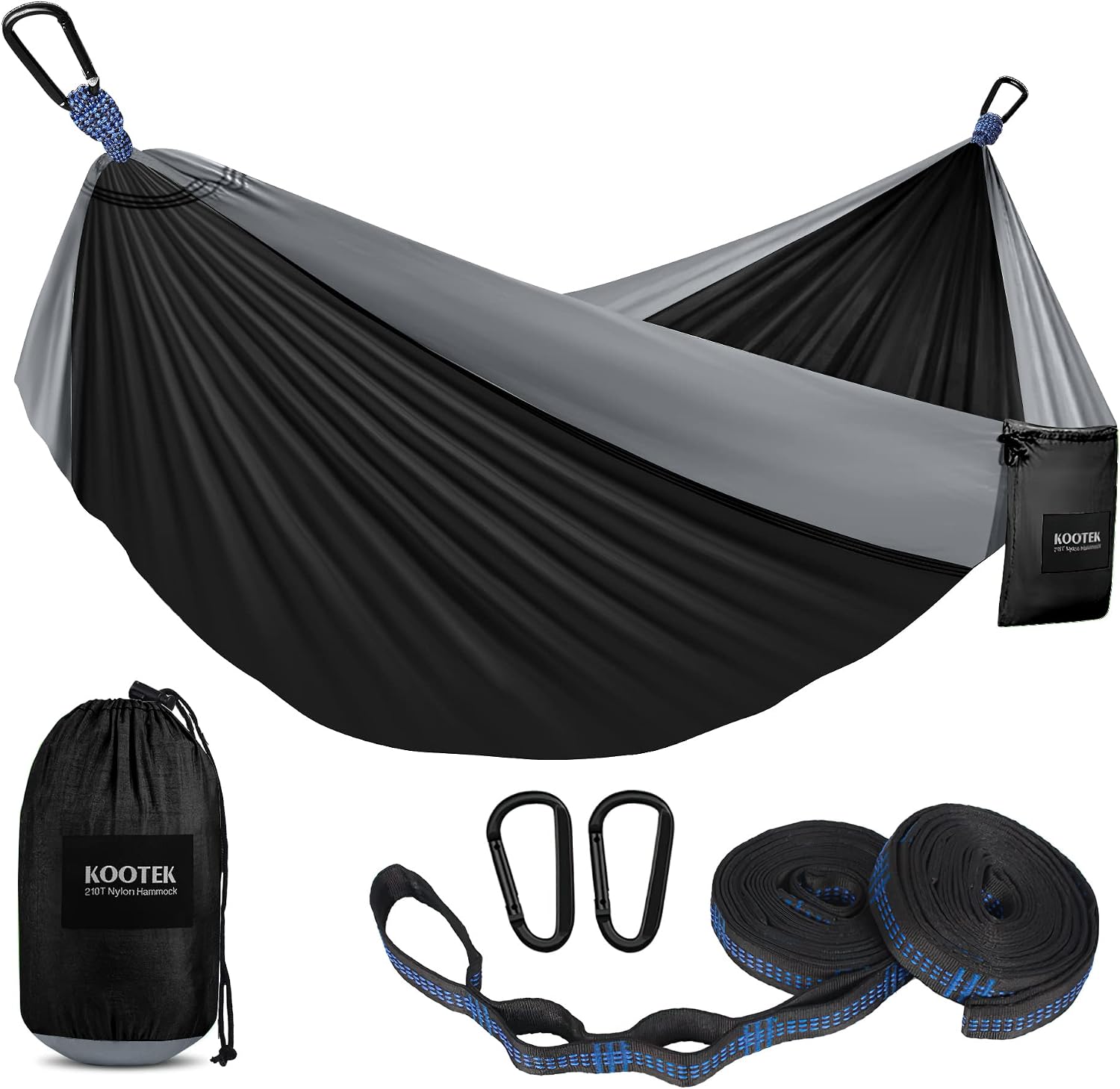
The best parachute nylon hammock I've tested is the Kootek Double, because it nails the trifecta of price, comfort, and durability better than any other budget option I've slept in over the last five years. It's not perfect, but at roughly ~$20, it's the one I keep buying as gifts.
Pros
- Soft, breathable 210T nylon taffeta that packs down to the size of a grapefruit
- 10-foot tree straps with 14 adjustment loops make setup easy on almost any tree spacing
- Survived a full Pacific Northwest season without fading or ripping
Cons
- The "double" name is a lie; it fits one adult and a dog comfortably, not two average-sized adults
- Fabric is thin enough to let light through, so don't expect privacy
- Straps broke on rough ceiling hooks in my shop, which was my fault but worth knowing
Compared to the competition
The Kootek sits between the SZHLUX and the GAFETE in my backyard test rig. The SZHLUX (around ~$18) has a slightly softer feel right out of the bag, but the fabric stretches more overnight. I woke up an inch from the ground twice with that one before I learned to hang it higher.
The GAFETE (around ~$22) is the only one of the three that actually fits two smaller people, but the end loops are fatter and won't accept standard S-hooks, which is a frustrating way to learn about hardware standards.
The Kootek hits the sweet spot. It doesn't have the softest fabric, and it doesn't have the widest lay, but it holds its shape better than the SZHLUX and has standard-compatible hardware that the GAFETE lacks. That's why I own five of them.
Design
The Kootek is 108 inches long and 59 inches wide, which is standard for a "double" that's really a single with extra room. The 210T nylon taffeta is the same material you'll find on hammocks costing four times as much.
It's soft enough to not feel coarse against the skin, and it's surprisingly cool in the summer. I felt like it was going to be hot because the fabric is quite thin and lets the wind and light through, but the airflow underneath keeps you comfortable.
I stand corrected on that one.
The suspension is where I check first. The carabiners are aluminum, which is good. Steel adds weight you don't need. The end loops are sewn, not tied, which is important because a tied loop is a failure point. The included straps are 10 feet long with 14 adjustable loops. That gives you a lot of flexibility on tree spacing, and the wide webbing protects the trees better than rope ever will.
The whole thing weighs 1.6 pounds including straps. Packed size is about the size of a loaf of bread, maybe smaller. It fits in a suitcase, fits in a backpack, fits in the side pocket of my fishing pack. That's the whole point of parachute material.
Performance
Setup time is under five minutes with the included straps. Loop the strap around the tree, clip the carabiner, adjust the height. Easy.
Here's the thing about hang height. You'll want to hang this higher than you think it should be because it has a lot of stretch once you put weight in it. I was an inch from the ground by midnight the first time I used it. I hung it at chest height and by the time I got in, I was practically sitting on the dirt. Hang it at eye level or above, and you'll be fine.
The lay is where the Kootek separates itself. Without spreader bars, it wraps around you more like a cocoon style, which is the default for this category. Some people hate that. I think it's the whole point.
The diagonal lay is easy to find, and once you're at that angle, you're flat. That's not true of every budget hammock.
The GAFETE has a slightly flatter lay, but it comes at the cost of that awkward hardware.
Durability
The fabric is thin. That's a feature, not just a flaw. The same material that lets wind and light through is what makes these things pack down so small. But thin means it rips easier than a heavyweight canvas hammock. I've had a ~$15 unbranded special tear on day two, which is not a hammock, that's a napkin with straps. The Kootek has held up better than that.
I've had mine hanging between two oak trees in the backyard for two summers now. It's been through rain, wind, and the occasional squirrel investigation. The color hasn't faded noticeably, and the fabric hasn't ripped.
Juniper, my border collie mix, has claimed it as hers. She gets in, curls up, and looks at me like I'm interrupting something.
If she's willing to put her claws on it, it's durable enough.
One note on the straps. They broke in the first few uses in my shop, which I think was from the roughness of the ceiling hooks I used. That was my fault. Cheap straps don't hold up to rough surfaces. On trees, with the included webbing, they've been fine.
Value
Twenty bucks. I've used mine every lazy weekend afternoon for two summers. That's less than a quarter per hang. I have five of these and they don't disappoint. I gave one to my neighbor as a housewarming gift. She texted me a week later saying she'd bought a second one for her husband because they kept fighting over the first. That's the review that matters.
The name brands charge four times as much for the same parachute nylon and a logo. At this price point, you're getting 90% of what the ~$80 hammock gives you. The fabric is a little thinner, the straps aren't quite as nice, but the core experience is there.
Should you buy it?
If you want a hammock for camping, backyard lounging, or throwing in your trunk for impromptu naps, buy the Kootek. It's worth it for about ~$20. If you're two average-sized adults looking for a hammock to share, skip it. You'll be very close friends, and not in a good way. Get two singles instead.
What I'm testing next
I'm working through a batch of budget hammocks to find the best one under ~$25, and I've got a GAFETE and a couple of unbranded ones hanging in my backyard right now. I'm also trying to figure out which one survives a full season of weather without fading or ripping. The SZHLUX is close to dethroning the Kootek, but it hasn't done it yet.